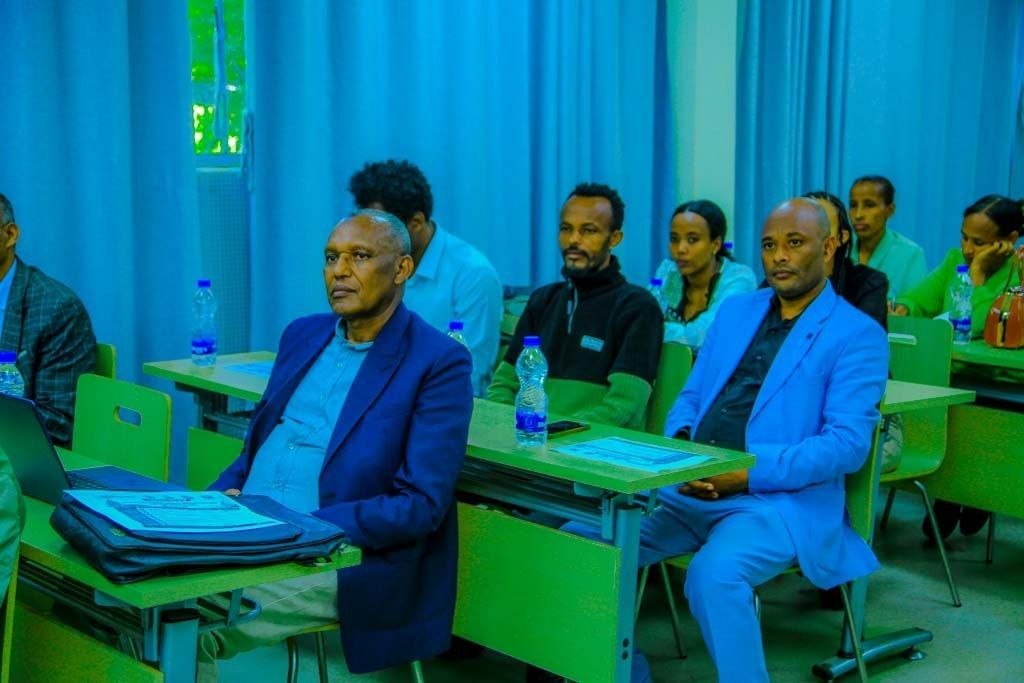
 Wollega University conducted a stakeholder workshop on “Water Security, Livelihoods and Gender Resilience to Climate Change in the Anger-Didessa Sub-Basin." The workshop brought together stakeholders and researchers to discuss water security, rural livelihoods, gender resilience, climate change adaptation, and nature-based solutions in the Anger-Didessa Sub-Basin.
Following the formal opening remark by Research andTechnology transfer Vice President, Dr. Diriba Dhiba , detailed presentations were delivered on four different but interrelated topics.
Dr.Dassaalegn Obsi, from Jimma University presented an Overview of Completed and Ongoing Components of the ABC Dry Basin Project. The presentations provided participants with evidence-based insights into the challenges and opportunities associated with water security, livelihoods, environmental change, and gender resilience.
The workshop particularly emphasized the importance of enabling farmers to produce and effectively use organic fertilizer as a sustainable means of improving soil health and agricultural productivity. It was highlighted that promoting locally produced organic fertilizer could contribute to improved agricultural yields while also providing farmers with practical and affordable alternatives to conventional inputs.
Speaking about the ABC Dry Basin Project, Mr.Mitiku Badhasa, workshop coordinator, and the Co-PI of the ABC Dry Basin Project team, explained that in Ethiopia, the project is being implemented collaboratively by Wollega University and Jimma University. Mr. Mitiku further explained that the Wollega University team is undertaking various research activities, providing training to farmers, and working extensively on water management and climate change-related issues. As part of these efforts, a “Living Lab” has been established at a model farmer’s site in Nagasa Kebele to demonstrate the preparation and use of organic fertilizer.
The workshop brought together representatives from Wollega University, Jimma University, the District Agriculture Office, and the District Climate Change Office. Participants actively engaged in extensive discussions and reflections on the research findings and presentations, sharing experiences.
The workshop was concluded with constructive discussions aimed at strengthening evidence-based approaches to water security, sustainable livelihoods, climate change adaptation, and gender resilience in the Anger-Didessa Sub-Basin.

Center of Excellences
Important Establishments
Systems
Looking for
Campuses
Main Campus (Nekemte)
Gimbi Campus(Faculty of Social Science and Humanity, Resource Mgmt. and Economics, Natural and Environmental Science , Business and Development )
Shambu Campus(Fuculty of Agriculture, Technology, Resource Mgmt. and Economics )