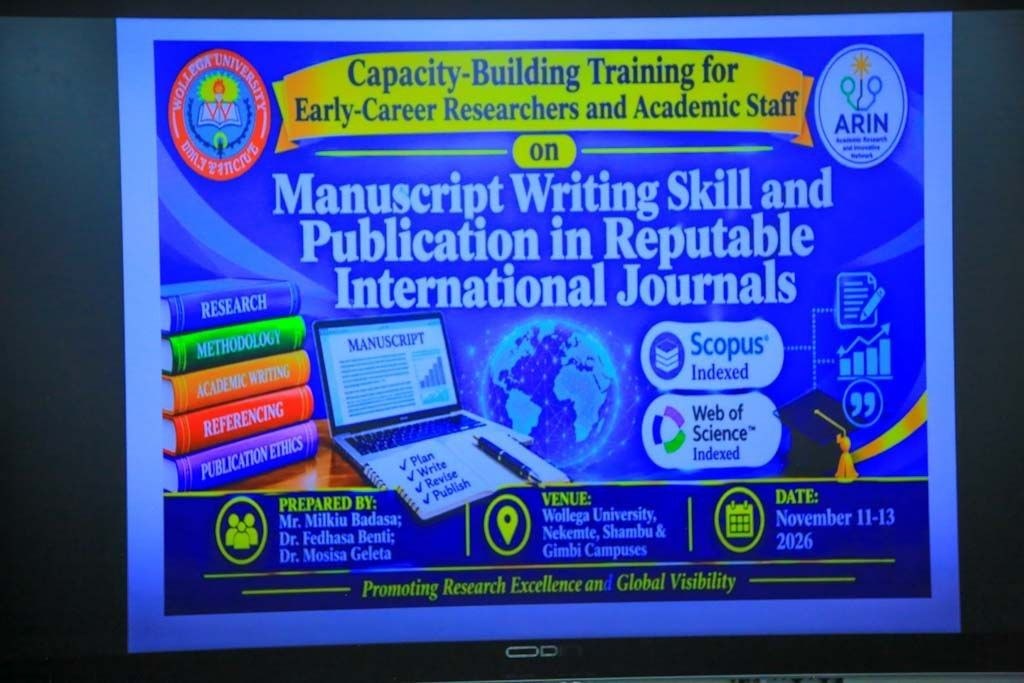
Wallaga University has today commenced a three-day comprehensive training program on Scientific Manuscript Writing and Publication, aimed at strengthening the research, academic writing, and scientific publication capacities of its academic staff and researchers.
The training is being conducted simultaneously in five designated smart rooms and training centres across the University, providing participants with practical knowledge and essential skills to improve the quality, visibility, and impact of their research outputs.
The official opening of training on manuscript preparation and research publication was delivered by Dr. Diriba Diba, Vice President for Research and Technology Transfer at Wallaga University. In his welcoming remarks, Dr. Diriba expressed his appreciation to the trainers, coordinators, and participants for their contributions and commitment to strengthening the University's research and publication culture.
Emphasizing the importance of scientific publication, he noted that conducting research alone is not sufficient; researchers must also develop the capacity to communicate, disseminate, and share their findings with the wider scientific community. He highlighted that published research contributes to the advancement of scientific knowledge, stimulates new ideas, and provides evidence-based solutions to societal challenges.
He further underlined that researchers commonly encounter challenges in scientific writing and publication, including manuscript preparation, selecting reputable journals, understanding publication ethics, and avoiding plagiarism. He stressed the importance of publishing in credible and internationally recognized journals, increasing the University's scholarly output, and ensuring that research findings contribute meaningfully to scientific advancement.
Dr. Diriba also emphasized that research integrity must remain at the heart of scientific publication. He encouraged participants to actively engage in the training, exchange experiences, and apply the knowledge and skills acquired beyond the training sessions. He urged facilitators to make the sessions as practical and interactive as possible
.In his address, he further explained that the impact of researchers should not be measured solely by the research questions they formulate or the experiments they conduct, but also by the contributions their findings make to the advancement of scientific knowledge and the wider research community. He officially declared the training open by reaffirming the University's commitment to strengthening research capacity and publication performance.
The three-day training focuses on equipping participants with the theoretical knowledge and practical skills required for scientific manuscript preparation and publication. Major areas of emphasis include an introduction to scientific publishing and the importance of scholarly publications; scientific publication requirements and scholarly output criteria under the Times Higher Education (THE) World University Rankings; types of scientific articles and the structure and purpose of research manuscripts; an overview of Scopus and Web of Science databases; identifying reputable and internationally recognized academic journals; journal metrics, indexing systems, and publication standards; research publication ethics, including plagiarism, authorship, and conflicts of interest; enhancing research visibility and citation impact through ORCID, Google Scholar, and ResearchGate; understanding the IMRAD structure (Introduction, Methods, Results, and Discussion) of scientific papers; and practical approaches to writing, organizing, and preparing research manuscripts for publication.